How to Clean and Maintain Quartz Countertops: The Complete 2026 Care Guide
Imagine it’s Saturday night and a glass of deep red Cabernet topples across your pristine, marble-look quartz. Your heart sinks as you wonder if that beautiful white surface is ruined forever. Learning how to clean and maintain quartz countertops shouldn’t feel like a high-stakes chemistry experiment. You’ve invested in your kitchen to create a sanctuary for your family, and it’s natural to feel protective of those stunning surfaces.
We understand the confusion. With so many products on the shelf, from ten dollar daily sprays to twenty dollar disinfectant kits, it’s hard to know what’s truly safe. With quartz now accounting for over 40% of the market in many developed economies, we know how vital these surfaces are to your home’s value and aesthetic. You likely already believe that your countertops should be the most durable part of your kitchen. However, the secret to their longevity isn’t about aggressive scrubbing; it’s about chemical intelligence and protecting the resin bond that holds the engineered stone together.
This 2026 guide promises to turn you into a stone care expert. We’ll provide a clear, simple daily routine and the confidence to handle accidental spills without panic. You’ll learn exactly which household cleaners to avoid so you can maintain that breathtaking showroom look for decades to come.
Key Takeaways
- Discover why the unique composition of engineered stone provides a bacteria-resistant foundation for your kitchen sanctuary.
- Master the “less is more” philosophy of how to clean and maintain quartz countertops to preserve their stunning showroom shine without harsh chemicals.
- Gain the confidence to handle tough spills and dried-on debris using expert-approved tools like microfibre cloths and plastic scrapers.
- Protect your long-term investment by identifying the hidden risks of thermal shock and mechanical damage that often catch homeowners off guard.
- Learn how proper stone care extends to the rest of your kitchen, specifically protecting the vital seams between your countertops and cabinetry.
Understanding Quartz Composition: Why Care Matters
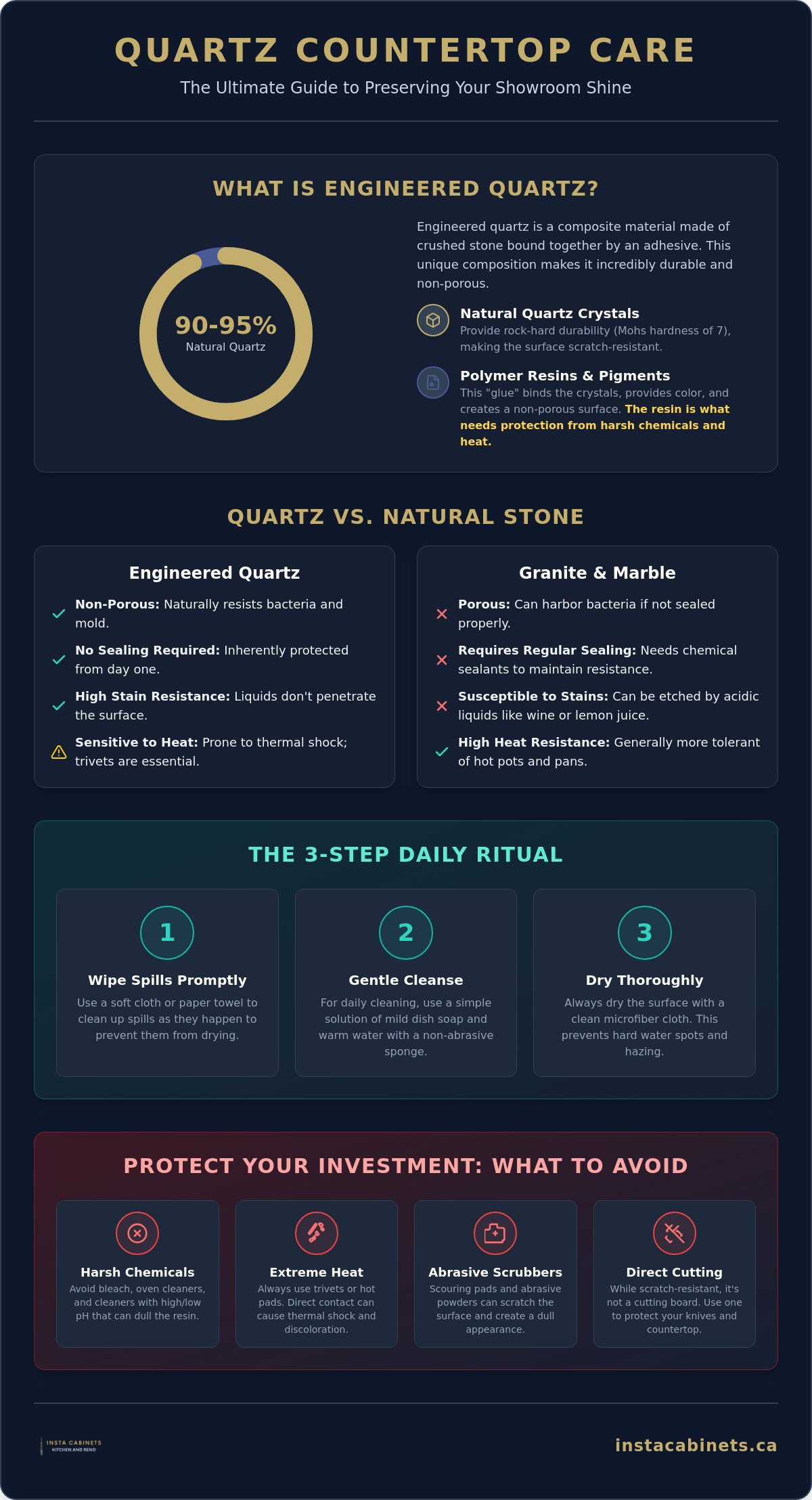
Your quartz countertops are more than just a surface; they are a masterpiece of modern engineering designed to withstand the daily rhythm of a busy home. Unlike granite or marble slabs pulled directly from the earth, quartz is an engineered stone. Most high-quality slabs consist of roughly 90 to 95 percent crushed natural quartz crystals. These crystals are held together by high-performance polymer resins and pigments. This specific Engineered Stone Composition creates a surface that is incredibly dense and virtually non-porous. Because there are no microscopic pores for liquids to seep into, your countertops are naturally resistant to the bacteria and mold that can plague other stone surfaces.
Understanding this structure is the first step in learning how to clean and maintain quartz countertops effectively. While the quartz crystals provide the hardness, the resin acts as the “glue” that holds your kitchen sanctuary together. It’s this resin, rather than the stone itself, that requires your protection. When you clean your surfaces, you aren’t just wiping away crumbs; you are preserving the integrity of the polymer bond. By adopting the right foundational habits, you can enjoy a truly maintenance-free lifestyle that keeps your kitchen looking pristine without the constant worry of permanent damage.
The Science of the Resin Bond
Resins are the unsung heroes of your countertop’s beauty, yet they are susceptible to chemical etching. Many common household cleaners have an extremely high or low pH balance. These chemicals can actually break down the polymer binders over time, leading to a dull or cloudy appearance that no amount of scrubbing can fix. You should also consider environmental factors like UV light. Prolonged exposure to direct sunlight or intense heat can cause these binders to yellow or become brittle. While quartz crystals boast a Mohs hardness rating of approximately 7, the resin binder is significantly softer and more reactive to environmental stressors.
Quartz vs. Natural Stone: Maintenance Differences
One of the greatest joys of choosing quartz is that it never requires professional sealing. Marble and granite owners must regularly apply chemical sealants to maintain stain resistance, but your quartz surface is inherently protected from the day it’s installed. This durability makes it a perfect centerpiece for a professional kitchen remodel in Mississauga, where homeowners prioritize both luxury and daily efficiency.
There is a small trade-off for this convenience. While quartz offers better stain resistance than natural stone, it has a higher sensitivity to thermal shock. Knowing how to clean and maintain quartz countertops means respecting these boundaries. By understanding that your countertop is a blend of rock-hard crystal and sensitive polymer, you can clean with confidence and ensure your kitchen remains a stunning haven for decades.
The Daily Cleaning Ritual: Preserving the Showroom Shine
Maintaining that radiant showroom glow doesn’t require an arsenal of harsh chemicals. In fact, a “Less is More” philosophy is the cornerstone of effective care. Because quartz is engineered with a protective resin bond, heavy-duty cleaners are often your worst enemy rather than your ally. These aggressive substances can strip away the factory finish, leaving your once-vibrant surface looking dull and lifeless. When you master how to clean and maintain quartz countertops through a consistent daily habit, you ensure your kitchen remains the inviting sanctuary you’ve always envisioned.
If you live in the Greater Toronto Area, you’re likely familiar with the specific challenges of local hard water. Cities like Mississauga and Toronto often have mineral-rich water that can leave a stubborn, cloudy film on your surfaces if left to air dry. This mineral buildup, known as hazing, is particularly visible on darker quartz slabs. The secret to preventing this isn’t found in a bottle of bleach; it’s found in the simple act of drying your counters after every use. By removing moisture before it evaporates, you stop calcium and magnesium deposits from bonding to the resin.
The 3-Step Daily Routine
Consistency is the key to longevity. Follow this simple process every evening to keep your surfaces pristine:
- Step 1: Clear the Debris. Use a dry, soft microfiber cloth to sweep away crumbs and dust. This prevents micro-scratches that occur when grit is pushed around by a wet sponge.
- Step 2: Apply a pH-Neutral Solution. Mix a few drops of mild dish soap with warm water. Wipe the surface gently to lift oils and light spills. This gentle approach protects the polymer binders we discussed earlier.
- Step 3: The Buff and Dry. Use a fresh, dry microfiber towel to buff the surface in a circular motion. This step is vital for a streak-free finish and prevents water spots.
Safe vs. Unsafe Cleaners Checklist
Knowing what to keep under your sink is just as important as knowing what to throw away. Stick to these guidelines to avoid permanent chemical damage:
- Approved Ingredients: Mild surfactants (dish soap) and diluted isopropyl alcohol (70% concentration mixed with water) for occasional disinfection.
- The “Never Use” List: Bleach, ammonia, and highly acidic cleaners like vinegar or lemon-based sprays. These can cause chemical etching.
- Avoid Caustic Chemicals: Oven cleaners and paint strippers will cause immediate, irreparable damage to the resin.
- Glass Cleaners: While tempting for a quick shine, products like Windex often contain ammonia or dyes that can lead to surface discoloration over time.
By sticking to these gentle methods, you protect the heart of your home for years to come. If you’re currently planning a kitchen renovation, choosing a low-maintenance surface like quartz is one of the best decisions you can make for a stress-free lifestyle.
Advanced Stain Removal: Troubleshooting Common Kitchen Spills
Even in the most carefully managed kitchen, life happens. While we’ve discussed the non-porous nature of engineered stone, it’s a common misconception that quartz is entirely stain-proof. In reality, the “non-porous” claim has a functional time limit. Highly pigmented substances like turmeric, beet juice, or red wine can eventually bond with the surface resin if left to sit for several hours. Mastering how to clean and maintain quartz countertops involves more than just a daily wipe; it requires a strategy for those moments when a spill isn’t caught immediately. Acting fast is your best defense, but when a mark lingers, a more targeted approach is necessary.
Sometimes, what looks like a permanent scratch is actually a “metal mark.” This occurs when a metal pot, pan, or knife rubs against the hard quartz crystals, leaving a trail of metal residue behind. Because quartz is harder than most metals, it acts like a file, shaving off a microscopic layer of the tool. These marks can often be removed with a soft white eraser or a gentle, non-abrasive cream cleanser. However, if you encounter deep chips or cracks, professional repair is the safest route. In 2026, the national average for professional countertop repair typically ranges from $300 to $500 for standard chips, ensuring your sanctuary is restored without the risk of further damage.
This principle of professional restoration applies to other high-value surfaces as well; for example, if you’re dealing with chips in your vehicle’s glass, you can read more about how specialists like Auto Glass Ottawa manage insurance coverage for such repairs.
Lifting Organic Stains (Wine, Coffee, Tea)
For stubborn organic pigments like coffee or tea, a simple paste of baking soda and water is an excellent first step. Apply the paste directly to the area and let it sit for five to ten minutes before wiping it away with a damp microfiber cloth. This gentle lifting action often removes the stain without stressing the resin bond. If the mark persists, you might consider a specialized quartz cleaner. Products like Granite Gold Daily Cleaner, often priced around $9.99, are formulated to handle these pigments safely. For more aggressive organic stains, the “soak and wait” method using a damp paper towel and a pH-neutral cleanser can work wonders over a thirty-minute period.
Removing Ink, Markers, and Adhesives
Accidents involving permanent markers or sticky residues from grocery labels require a different set of tools. You can safely use an adhesive remover like Goo Gone on quartz surfaces to lift stubborn gunk. For ink or marker accidents, a small amount of denatured alcohol on a cotton ball is usually effective. The most critical step in this process is the “rinse twice” rule. After using any solvent or adhesive remover, you must wash the area thoroughly with mild soap and water to ensure no chemical residue remains to interact with the polymer binders. For dried-on substances like candle wax or bread dough, skip the chemicals and use a plastic scraper. Hold it at a shallow angle to gently pop the debris off the surface without gouging the stone.
Preventative Protection: What to Avoid at All Costs
While daily cleaning keeps your surfaces bright, true longevity depends on what you don’t do to your stone. Protecting your investment means understanding the physical limits of engineered surfaces. Even the most durable materials have vulnerabilities. When you learn how to clean and maintain quartz countertops, you also learn to act as a guardian for the resin bond we discussed earlier. Avoiding preventable damage is far easier than trying to repair it later. By following a few simple rules, you can ensure your kitchen remains a beautiful, functional sanctuary without the need for expensive surface restoration.
Beyond the kitchen, remember that quartz is strictly an indoor material. Constant exposure to UV light will eventually break down the pigments and binders, causing the stone to fade or yellow. If you are undertaking other home projects like painting or plumbing, cover your surfaces with a heavy-duty drop cloth. Harsh chemicals found in paint strippers or drain cleaners can cause immediate chemical etching that no daily cleaner can fix. If you’re ready to upgrade your space with surfaces built to last, consider a professional kitchen renovation that prioritizes both style and durability.
Heat Management in the Kitchen
Thermal shock is perhaps the most significant threat to your countertops. While the quartz crystals are heat-resistant, the polymer resins are not. When a scorching pot is placed directly on the surface, the rapid temperature change can cause the material to expand unevenly; this leads to a permanent crack or a “white ring” burn mark. It is a scientific fact that the resin binders in quartz can begin to melt or discolour at temperatures as low as 150°C. Always use trivets or hot pads for every item pulled from the stove or oven. This rule also applies to heat-generating appliances like air fryers, slow cookers, and toaster ovens, which can radiate enough heat to damage the surface over time.
Cutting and Impact Safety
The myth of the “scratch-proof” surface often leads to risky kitchen habits. Quartz is exceptionally hard, but it is not invincible. Never chop or slice food directly on your countertops. Not only will this dull your professional knives, but repetitive cutting in the same spot can eventually wear down the resin finish. You should also be mindful of “point-load” impacts. Dropping a heavy cast iron skillet can cause the stone to chip, especially along the edges or at mitred joins where the material is most vulnerable. These areas are the structural weak points of any installation and require gentle handling to maintain their seamless look. Knowing how to clean and maintain quartz countertops means respecting these physical boundaries to avoid deep mechanical damage.
Integrating Countertop Care with Your Custom Cabinetry
A truly beautiful kitchen is a cohesive ecosystem where every material supports the next. When you consider how to clean and maintain quartz countertops, you are simultaneously extending the life of your custom kitchen cabinets. These two elements meet at a critical juncture; the seam where engineered stone rests upon high-quality wood or cabinetry finishes. Neglecting this boundary can lead to moisture damage that compromises your entire renovation. By viewing your kitchen as a singular sanctuary, you can adopt habits that protect both the stone and the craftsmanship beneath it.
The ease of your daily maintenance often starts long before you pick up a microfiber cloth. It begins with a professional installation that ensures every joint is tight and every surface is level. Precise craftsmanship reduces “trap points” where crumbs and liquids gather, making your cleaning routine faster and more effective. When your stone is fitted with expert care, you spend less time digging debris out of gaps and more time enjoying the heart of your home. This synergy between materials is what transforms a standard remodel into a long-term domestic investment.
Protecting Cabinet Joins from Liquid Seepage
You should never “flood” your counters with water or cleaning solutions, especially near the sink or along the backsplash. Excess liquid can easily migrate over the edge and seep into the fine joins of your cabinetry. This hidden moisture can cause wood to swell or finishes to peel over time. It’s a good practice to check the silicone seal between your countertop and cabinets at least once a year. At Instacabinets, we prioritize a precision fit during the installation phase to minimize these risks. Our goal is to ensure your sanctuary remains structurally sound and visually stunning without the stress of water damage.
A Holistic Approach to Kitchen Longevity
Your cleaning routine should reflect the specific needs of your cabinets and designs. Using the right techniques for your quartz also protects the surrounding textures and finishes. High-quality craftsmanship is an investment that pays off in reduced stress and simplified care. We invite you to visit our Mississauga showroom for a hands-on care demonstration. Our experts can show you exactly how to clean and maintain quartz countertops while preserving the harmony of your entire kitchen. Ultimately, your home is your sanctuary. With these expert-approved techniques, your kitchen will remain a place of joy, connection, and pride for decades to come.
Preserving Your Kitchen Sanctuary for Decades to Come
Your kitchen is the vibrant heart of your home. Your quartz surfaces are the foundation of that sanctuary. By mastering simple daily rituals and respecting the resin bond, you ensure your investment remains stunning for years. We’ve explored how a “less is more” approach prevents etching and how preventative habits stop thermal shock. Understanding how to clean and maintain quartz countertops is about partnering with your materials to create a lasting haven that’s beautiful and functional.
Even for those outside the GTA, seeking out experienced professionals such as Sani-Tech Victoria can ensure your home maintenance routine is supported by decades of cleaning expertise, keeping your sanctuary spotless from top to bottom.
At Instacabinets, we’ve served the Greater Toronto Area for over eight years as expert installers. We specialize in premium quartz sourcing and manage your entire kitchen renovation from the first design to the final finish. Our team handles the complex technical details so you don’t have to. Book a design consultation at our Mississauga showroom to find your perfect quartz match. We’re excited to help you design a space that’s both luxurious and effortless to maintain.
Frequently Asked Questions
Can I use vinegar or lemon juice to clean my quartz countertops?
No, you should avoid using vinegar or lemon juice on your quartz surfaces. These liquids are highly acidic and can cause chemical etching on the polymer resins that bind the stone together. While the quartz crystals themselves are tough, the acidic reaction can lead to permanent dulling or discoloration. Stick to pH-neutral cleaners like mild dish soap and warm water to preserve the finish.
Is it okay to use Windex or other glass cleaners on quartz?
It is best to avoid Windex and other common glass cleaners for daily maintenance. Many of these products contain ammonia or strong dyes that can eventually break down the resin bond over time. While they provide a quick shine, the long-term chemical exposure can lead to surface clouding. Diluted isopropyl alcohol is a much safer alternative if you want a streak-free, disinfected finish.
Does quartz need to be sealed like granite or marble?
No, quartz never requires sealing because it is a non-porous engineered stone. Unlike granite or marble, which have microscopic pores that absorb liquids, quartz is made by bonding crystals with resin. This process creates a surface that is naturally resistant to bacteria and moisture from the day it is installed. You save time and money by skipping the annual sealing process required by natural stone.
What happens if I put a hot pan directly on my quartz counter?
Placing a hot pan directly on your counter can cause permanent damage known as thermal shock. The intense heat can cause the polymer resins to melt or discolor at temperatures as low as 150°C. In extreme cases, the rapid temperature change can even cause the slab to crack. Always use a trivet or hot pad to protect your sanctuary from preventable heat damage.
How do I remove the “cloudy” look from my quartz surface?
A cloudy look is often caused by hard water mineral buildup or the use of improper, high-pH cleaners. To restore the shine, use a specialized quartz cleaner or a mixture of mild soap and distilled water to lift the film. Always dry the surface thoroughly with a microfiber cloth after cleaning. This prevents local hard water minerals from bonding to the resin and creating that hazy appearance.
Can I use a Magic Eraser to get rid of stubborn stains on quartz?
You should not use a Magic Eraser on your quartz countertops. While they feel soft, these sponges are actually highly abrasive and can wear down the factory polish of your stone. Using them can leave a permanent dull spot that is visible in the light. For stubborn messes, stick to the plastic scraper technique or a baking soda paste mentioned earlier in this guide.
Why are there grey marks on my quartz that look like scratches?
Those grey marks are usually metal transfer from pots, pans, or knives rather than actual scratches. Because quartz is harder than most metals, it acts like a file and shaves off a tiny amount of the metal tool. You can usually remove these marks with a soft white eraser or a gentle, non-abrasive cream cleanser. It is a simple way to maintain the showroom look of your kitchen.
How often should I deep clean my quartz countertops?
You don’t need a frequent deep-cleaning schedule if you follow a consistent daily routine. Most homeowners find that a monthly check for mineral buildup or accidental resin-safe adhesive removal is sufficient. Learning how to clean and maintain quartz countertops is mostly about preventing damage before it happens. A quick daily wipe-down is the most effective way to keep your kitchen looking pristine for decades.